Benefits of Herbal Powders in Natural Hair Care Products
The growing preference for plant-based beauty solutions has changed the way consumers and cosmetic brands approach hair care. Instead of relying only on conventional synthetic ingredients, many brands are exploring botanical ingredients that can be incorporated into shampoos, hair masks, conditioners, scalp treatments, herbal hair colors, and other personal care formulations. Among these ingredients, herbal powders for hair care have become increasingly popular because they are versatile, easy to formulate with, and available from a wide range of traditional botanicals.
Herbal powders are generally prepared from carefully processed leaves, roots, fruits, seeds, flowers, or other botanical materials. Depending on the plant used, these powders may contribute natural color, conditioning properties, cleansing characteristics, antioxidant compounds, or other functional benefits to a hair care formulation. However, the quality of the finished ingredient depends heavily on botanical identity, sourcing, processing, hygiene, moisture control, particle size, testing, and packaging.
For cosmetic manufacturers and private label brands, selecting the right herbal powder is therefore not simply a matter of choosing a popular plant. The ingredient must be appropriate for the intended formulation and supported by consistent quality documentation. A reliable manufacturing partner can help businesses select suitable botanical powders, define specifications, and develop products according to their target market and application.
If you are exploring botanical ingredients for commercial hair care formulations, our guide on how herbal powders are used in Ayurvedic cosmetic manufacturing provides additional information about their role in natural cosmetic development.
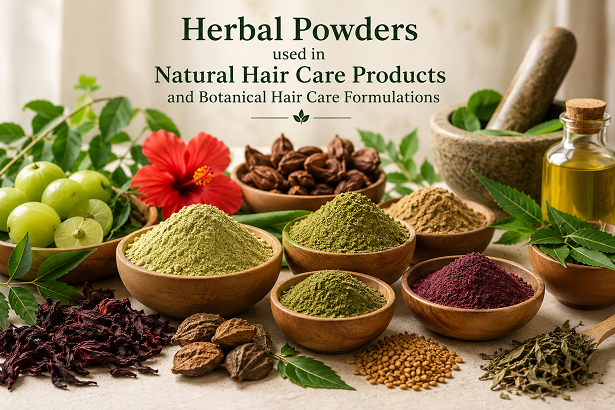
Benefits of Herbal Powders for Hair Care Products
One of the main advantages of herbal powders is their flexibility. A single botanical ingredient can be incorporated into different types of hair care products depending on its characteristics and the formulation requirements. This makes herbal powders particularly useful for brands developing natural, botanical, Ayurvedic-inspired, and plant-focused product ranges.
The actual benefit of a herbal powder depends on the botanical source and how it is processed. Manufacturers should avoid treating all herbal powders as interchangeable because different plants have different compositions, characteristics, and formulation behavior.
| Potential Benefit | Hair Care Application | Why It Matters to Formulators |
|---|---|---|
| Botanical ingredient profile | Hair masks, powders and treatments | Supports plant-based product positioning. |
| Natural conditioning potential | Hair masks and conditioning formulations | Can complement other conditioning ingredients. |
| Natural cleansing characteristics | Herbal cleansers and shampoo formulations | Useful in botanical-focused cleansing products. |
| Natural color contribution | Herbal hair color products | Useful for developing plant-based color formulations. |
| Antioxidant-rich botanical sources | Scalp and hair care formulations | Supports formulations built around botanical ingredients. |
| Formulation versatility | Powders, masks, cleansers and treatments | Allows brands to develop multiple products from botanical ingredients. |
| Consumer-friendly positioning | Natural and botanical beauty products | Aligns with growing interest in plant-derived formulations. |
Another important advantage is product differentiation. Natural hair care brands often need a clear ingredient story to distinguish their products in a competitive market. Carefully selected botanical powders can become part of that story when the ingredient source, processing method, quality specifications, and intended use are communicated accurately.
For example, amla powder is commonly associated with traditional Indian hair care practices, while other botanical powders may be selected for their cleansing, conditioning, color, or formulation characteristics. Businesses can therefore create different product concepts around different botanical ingredients instead of relying on a single universal formulation.
However, it is important for manufacturers and brands to make responsible product claims. The presence of a botanical ingredient does not automatically mean that a finished cosmetic product can legally make therapeutic or medical claims. Finished-product claims should be supported by appropriate evidence and should comply with the regulations applicable to the target market.
Popular Herbal Powders Used in Natural Hair Care Formulations
A wide variety of botanical powders can be considered for natural hair care products. The appropriate choice depends on the product concept, target consumer, formulation type, desired appearance, processing requirements, and regulatory market.
Some botanical powders are traditionally used in hair care, while others are selected because of their nutritional or phytochemical profiles. When developing a commercial product, manufacturers should evaluate the complete technical specification rather than selecting an ingredient based only on its popularity.
| Herbal Powder | Common Hair Care Use | Formulation Consideration |
|---|---|---|
| Amla Powder | Hair masks, herbal treatments and traditional hair care | Fine particle size and consistent botanical quality are important. |
| Shikakai Powder | Traditional herbal cleansing formulations | Suitable processing and controlled moisture are important. |
| Neem Powder | Scalp-focused and herbal hair care products | Botanical identity and microbiological quality should be verified. |
| Brahmi Powder | Herbal hair masks and botanical treatments | Consistent sourcing and powder quality support formulation repeatability. |
| Hibiscus Powder | Hair masks and botanical treatment products | Color, aroma and particle size can influence finished-product appearance. |
| Fenugreek Powder | Hair masks and conditioning formulations | Powder texture and moisture content can influence mixing behavior. |
| Indigo Powder | Natural and herbal hair color formulations | Pigment performance and processing consistency are especially important. |
| Henna Powder | Natural hair color and conditioning products | Botanical identity, purity and color performance require careful control. |
Among these ingredients, amla, indigo, and henna are particularly relevant to brands developing traditional or botanical hair care ranges. For businesses interested in plant-based hair color, our article on natural henna-based hair dye versus chemical hair color explains the broader differences between these product approaches.
Indigo powder is another important botanical ingredient for natural hair color formulations. It is commonly used alongside henna to create darker shades. Businesses sourcing indigo for commercial applications should pay particular attention to raw material quality, processing, laboratory testing, moisture control, and packaging. Our detailed guide on key factors in indigo powder manufacturing provides a deeper look at these manufacturing considerations.
The selection process should ultimately begin with the intended product rather than the ingredient itself. A manufacturer developing a cleansing powder may need a different botanical profile from a brand creating a conditioning hair mask or herbal hair color. This application-first approach helps reduce formulation problems and creates a more consistent finished product.
How to Choose High-Quality Herbal Powders for Hair Care Manufacturing
For commercial hair care brands, ingredient quality is one of the most important factors influencing product consistency. Herbal materials are agricultural products, which means their characteristics can naturally vary according to plant variety, growing conditions, harvesting practices, geographical origin, season, drying methods, and storage.
A professional herbal powder manufacturer should therefore have documented procedures for raw material selection, processing, quality control, testing, and batch traceability. Buyers should look beyond attractive pricing and evaluate whether the supplier can consistently meet agreed specifications.
Important factors to evaluate include:
- Botanical identity: The supplier should clearly identify the plant source and botanical name of the material.
- Raw material quality: Raw materials should be appropriately selected, sorted, and handled before processing.
- Processing hygiene: Production equipment and processing areas should be maintained under appropriate hygienic conditions.
- Moisture control: Excess moisture can negatively affect storage stability and increase contamination risks.
- Particle size: Consistent particle size helps improve mixing and formulation repeatability.
- Microbiological quality: Appropriate microbiological testing is important for botanical ingredients used in cosmetic formulations.
- Heavy metal testing: Depending on the botanical and target market, relevant contaminant testing may be required.
- Foreign matter control: Effective sorting and inspection procedures help maintain product cleanliness.
- Batch consistency: Manufacturers should have systems for maintaining consistent specifications from one production batch to another.
- Documentation: Buyers may require documents such as COA, SDS/MSDS, product specifications, and technical data.
- Packaging: Packaging should protect the powder from moisture, contamination, light, and handling damage.
- Traceability: Batch identification and appropriate records help businesses manage their supply chain more effectively.
For international buyers, supplier documentation is particularly important. A professional procurement process may require a Certificate of Analysis, specification sheet, safety documentation, country-of-origin information, packaging details, and other export documents depending on the destination country and product category.
The manufacturing environment also matters. Herbal powders should be processed using equipment and procedures designed to minimize contamination and cross-contact risks. Cleaning schedules, personnel hygiene, raw material handling, storage segregation, and pest-control procedures all contribute to a controlled production environment.
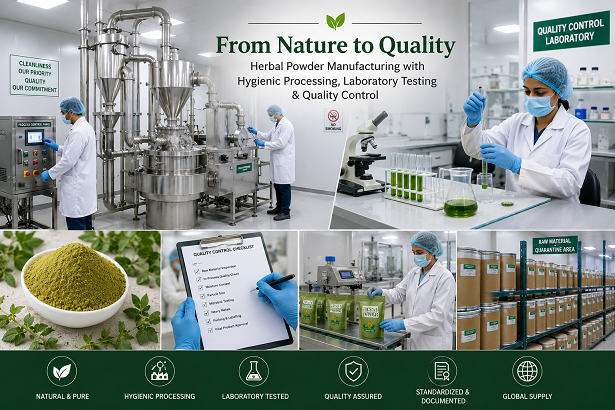
Packaging is another factor that is sometimes overlooked during sourcing. Even a properly manufactured herbal powder can experience quality problems if it absorbs moisture during storage or transportation. Export packaging should therefore be selected according to the product's characteristics, shipment duration, environmental conditions, and buyer requirements.
Businesses developing their own branded products can also consider OEM and private label manufacturing. This approach allows a brand owner to work with a manufacturer on product specifications, packaging formats, labeling, batch quantities, and other commercial requirements while focusing internal resources on branding and distribution.
For a broader understanding of botanical ingredient sourcing, you can also read our guide on why organic herbal powders are in high demand worldwide.
For general information on quality management standards used across manufacturing industries, businesses can refer to the International Organization for Standardization (ISO).
Frequently Asked Questions (FAQs)
1. What are herbal powders used for in hair care products?
Herbal powders can be used in hair masks, herbal cleansers, shampoos, scalp-focused products, conditioning treatments, natural hair color products, and other botanical hair care formulations. Their application depends on the characteristics of the individual botanical ingredient and the formulation objective.
2. Which herbal powders are commonly used for natural hair care?
Commonly used botanical powders include amla, shikakai, neem, brahmi, hibiscus, fenugreek, henna, and indigo. The most suitable ingredient depends on the intended product, formulation requirements, target market, and desired product characteristics.
3. Are herbal powders suitable for private label hair care products?
Yes. Herbal powders can be incorporated into private label hair care products when the selected ingredient is suitable for the intended formulation. Businesses should work with a manufacturer capable of providing consistent quality, appropriate documentation, packaging options, and batch specifications.
4. What should buyers check before purchasing herbal powders in bulk?
Bulk buyers should evaluate botanical identity, raw material quality, processing conditions, moisture, particle size, microbiological quality, relevant contaminant testing, packaging, batch consistency, documentation, manufacturing capabilities, and export experience.
5. Why is moisture control important for herbal powders?
Moisture control is important because excessive moisture can affect powder stability and may create conditions that encourage microbial growth. Proper drying, packaging, and storage help maintain the quality of botanical powders during transportation and storage.
6. Can herbal powders be used in herbal hair color products?
Certain botanical powders, particularly henna and indigo, are commonly used in natural and herbal hair color formulations. Their performance depends on botanical quality, processing, formulation technique, and appropriate use according to the intended product.
7. What documents should a professional herbal powder supplier provide?
Depending on the product and destination market, buyers may request documents such as a Certificate of Analysis (COA), Safety Data Sheet (SDS/MSDS), product specification sheet, technical information, batch details, and relevant quality or export documentation.
8. How can I choose the right herbal powder manufacturer?
Look for a manufacturer with reliable raw material sourcing, hygienic processing facilities, laboratory testing capabilities, documented quality procedures, batch traceability, appropriate packaging options, OEM or private label capabilities, and experience supplying international buyers.
If you want expert help, contact us and we will guide you accordingly.
Author
Conclusion
Herbal powders have become an important part of the natural hair care industry because they offer cosmetic brands a versatile way to incorporate botanical ingredients into different product categories. From traditional hair masks and cleansing formulations to herbal hair colors and private label treatments, different botanical powders can serve different formulation purposes.
However, the value of a herbal powder depends on more than the name of the plant. Botanical identity, raw material sourcing, hygienic processing, controlled drying, moisture management, particle size, laboratory testing, packaging, storage, and batch consistency all influence the quality of the finished ingredient.
For businesses developing natural hair care products, choosing a reliable manufacturer is therefore an important part of product development. A supplier that combines technical knowledge with consistent manufacturing and documentation can help reduce sourcing risks and create a stronger foundation for long-term product quality.
Whether you are launching a new herbal hair care brand, expanding an existing cosmetic range, developing private label products, or sourcing botanical ingredients in bulk, carefully evaluating the quality and suitability of herbal powders can help you make better formulation and procurement decisions.
Looking for Herbal Powders for Hair Care Products?
Shree Overseas Exports supplies herbal powders and botanical ingredients for cosmetic, personal care, herbal hair care, natural beauty, and private label applications. Our team can assist businesses with ingredient sourcing, bulk requirements, customized packaging, OEM manufacturing, and export-related requirements.
Whether you need a single herbal powder or are developing a complete natural hair care product range, our team can help you evaluate suitable options according to your product requirements and target market.