How to Choose the Best Lavender Oil Wholesale Supplier in India?
The demand for lavender oil continues to grow across cosmetics, personal care, aromatherapy, wellness products, soaps, fragrances, and natural formulations. For businesses purchasing lavender oil in commercial quantities, however, finding the right supplier is about much more than comparing prices.
A reliable lavender oil wholesale supplier in India should be able to demonstrate consistent product quality, suitable manufacturing practices, batch-level testing, dependable supply capacity, appropriate documentation, secure packaging, and professional export support. These factors become especially important when lavender oil is used as an ingredient in products that are sold under a cosmetic, personal care, wellness, or private-label brand.
India has a well-established botanical and essential-oil manufacturing sector, giving international buyers access to manufacturers, exporters, and private-label suppliers. But suppliers can differ significantly in their sourcing practices, processing capabilities, documentation, testing systems, and ability to maintain consistency between batches.
If you are comparing suppliers for the first time, this guide explains the practical factors that should be evaluated before placing a wholesale or bulk lavender oil order.
For additional background, you can also read our guides on what lavender essential oil is and its market demand, export standards for lavender essential oil, essential oil manufacturers in India, and how to choose a reliable essential oil exporter.
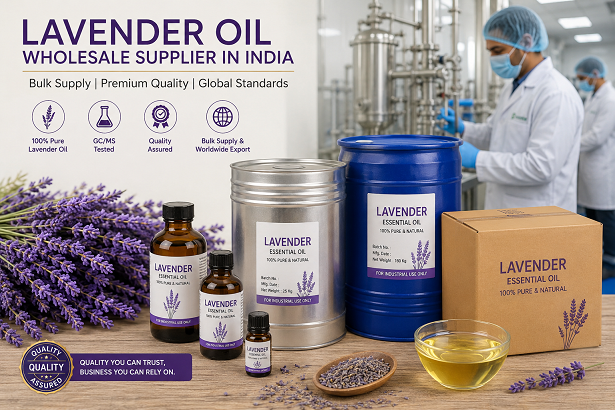
Why Choosing the Right Lavender Oil Supplier Matters
Lavender oil is a botanical ingredient, and its characteristics can vary according to the plant material, botanical source, cultivation conditions, extraction process, storage conditions, and handling practices. Two products marketed simply as “lavender oil” may therefore not have identical characteristics.
For a business, inconsistency can create practical problems. A change in aroma profile, appearance, analytical composition, packaging quality, or batch consistency may affect the performance of a finished formulation. This is why professional procurement teams generally evaluate the supplier as carefully as they evaluate the oil itself.
A dependable supplier should be able to clearly explain the product being offered, including its botanical identity, extraction method, origin information where applicable, available specifications, testing procedures, packaging options, and commercial terms.
For B2B buyers, the supplier should ideally function as a long-term manufacturing and supply partner rather than simply as a trading intermediary. This becomes even more important when a company needs recurring quantities, customized packaging, private labeling, or international shipments.
Before selecting a supplier, buyers should therefore consider several quality and commercial factors together instead of choosing a company solely because it offers the lowest quotation.
| Supplier Evaluation Factor | Why It Matters | What Buyers Should Check |
|---|---|---|
| Botanical Identity | Helps establish what type of lavender oil is being supplied. | Botanical name, plant part and product specification. |
| Quality Testing | Helps verify consistency, identity and product quality. | COA, relevant analytical reports and batch information. |
| Manufacturing Capability | Supports reliable production and repeat orders. | Facility, equipment, production process and capacity. |
| Bulk Supply | Important for brands and manufacturers with recurring demand. | MOQ, available pack sizes, lead time and production capacity. |
| Documentation | Supports procurement, formulation and export requirements. | COA, SDS/MSDS, specifications and relevant certificates. |
| Packaging | Protects the oil during storage and transportation. | Container material, sealing, labeling and export packaging. |
Key Factors to Consider When Choosing a Lavender Oil Wholesale Supplier
Once you have shortlisted potential suppliers, compare them using a consistent evaluation process. The following factors can help businesses make a more informed purchasing decision.
1. Check the Botanical Identity and Product Specification
One of the first questions to ask is exactly what lavender oil the supplier is offering. A professional product specification should identify the botanical source and provide relevant information about the product.
Depending on the application, buyers may need a particular lavender species or product grade. For example, Lavandula angustifolia is commonly associated with true lavender, but buyers should not assume that every product labeled simply “lavender oil” has the same botanical identity or composition.
Ask the supplier to provide the botanical name, extraction method, country or region of origin where relevant, available specification sheet, and batch documentation before making a large purchase.
2. Ask for Batch-Level Quality Documentation
Quality documentation is one of the most useful tools for B2B procurement. Instead of relying only on marketing statements such as “premium,” “pure,” or “high quality,” buyers should ask for documentation that corresponds to the actual product batch whenever applicable.
A Certificate of Analysis (COA) can provide important information about tested characteristics of a particular batch. Depending on the product and intended application, buyers may also request analytical information such as GC/MS data, physical characteristics, microbiological information where relevant, and other tests required by their specification.
GC/MS analysis is particularly useful for essential oils because it can provide a detailed picture of the volatile constituents present in the oil. However, buyers should evaluate the complete documentation and supplier quality system rather than treating one laboratory report as the only measure of supplier reliability.
3. Evaluate Manufacturing and Quality-Control Practices
A supplier's manufacturing environment can have a direct influence on product consistency. Ask whether the supplier manufactures the oil themselves or sources it from another party. If manufacturing is carried out in-house, ask about processing, storage, cleaning, quality control, batch identification, and traceability practices.
A professional manufacturer should have documented procedures for raw-material handling, production, equipment cleaning, storage, packaging, and release of finished batches.
Buyers can also review the supplier's applicable certifications and quality systems. Certifications should be evaluated according to the actual product and target market rather than treated as a substitute for product testing.
4. Confirm Bulk and Wholesale Supply Capability
A supplier may be able to provide small quantities but struggle when a customer moves to commercial production. This is why businesses should discuss expected monthly or annual requirements before selecting a long-term supplier.
Important questions include:
- What is the minimum order quantity?
- Which bulk pack sizes are available?
- What is the normal production lead time?
- Can the supplier handle repeat orders?
- Can supply volumes increase as the business grows?
- Are samples available before a commercial order?
For growing cosmetic and personal-care brands, supply continuity can be just as important as the initial product price.
5. Compare Pricing on a Total-Cost Basis
Wholesale buyers naturally compare prices, but the lowest quotation does not necessarily represent the lowest overall procurement cost.
A proper comparison should consider the oil specification, concentration or grade where applicable, packaging, testing documentation, minimum order quantity, shipping, lead time, payment terms, and after-sales support.
For example, a slightly higher-priced supplier that provides reliable batch documentation, consistent quality and secure export packaging may ultimately offer better value than a low-cost supplier whose product requires additional testing or creates formulation inconsistencies.
6. Review Packaging and Storage Practices
Essential oils should be protected from conditions that can negatively affect their quality during storage and transportation. The appropriate container depends on the product, quantity, destination, handling requirements, and customer specification.
Ask the supplier about available packaging formats, sealing methods, labeling, batch identification, and protection during transportation. Bulk orders may require different packaging solutions from small retail quantities.
The supplier should also provide appropriate storage recommendations so that the buyer can maintain product quality after delivery.
7. Check Export and Documentation Support
If you are purchasing lavender oil from India for an overseas market, documentation becomes an important part of supplier evaluation.
Depending on the destination and intended application, buyers may require commercial documents, product specifications, COA, SDS/MSDS, country-of-origin information, packaging details, shipping documents, and other market-specific documentation.
A supplier experienced in international trade can make the procurement process considerably easier by understanding common documentation and shipping requirements.
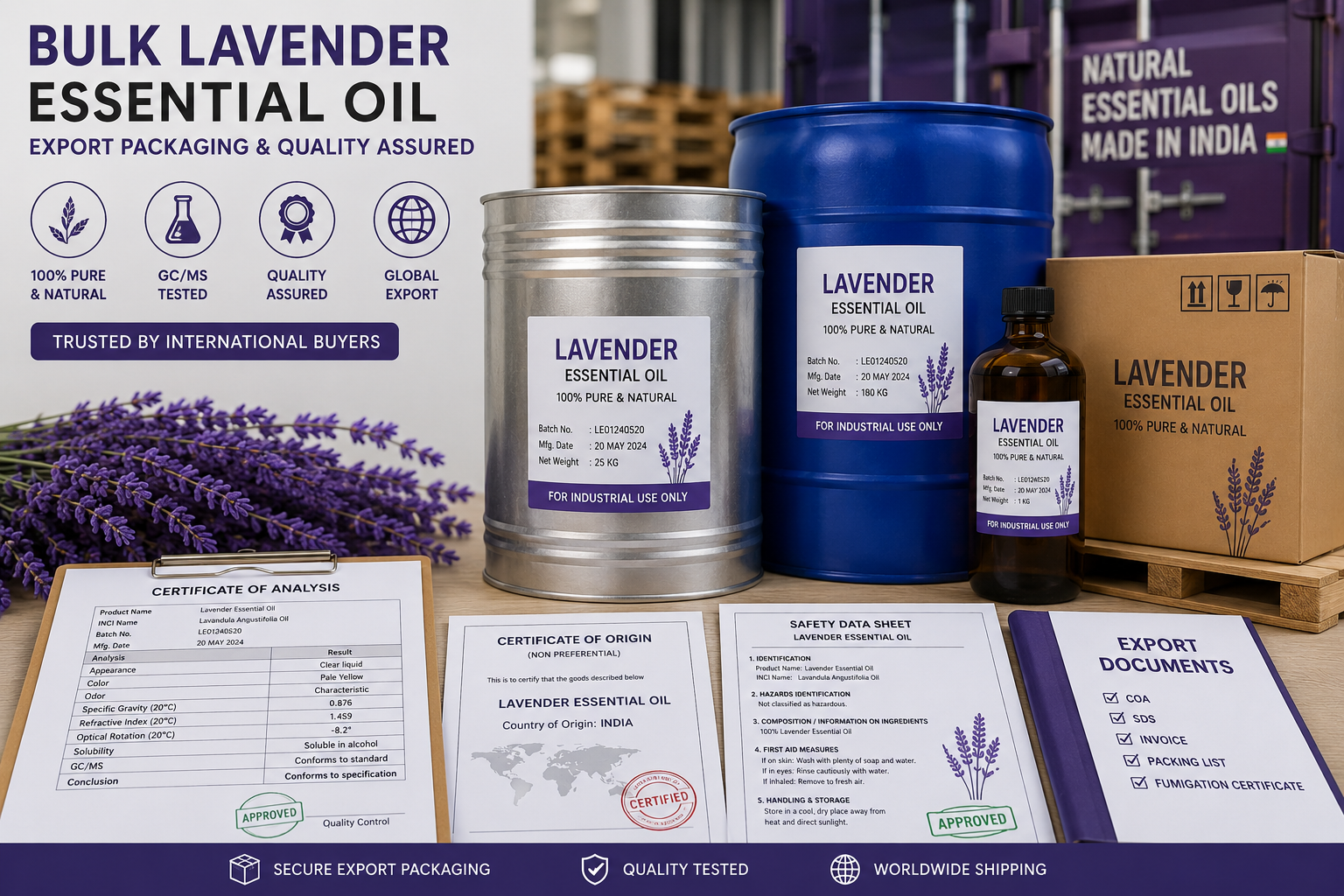
How to Evaluate and Compare Lavender Oil Suppliers in India
After collecting information from several suppliers, avoid making the decision based on one factor. A simple supplier comparison framework can help you identify the company that offers the best combination of product quality, reliability, documentation and commercial suitability.
| Evaluation Area | Questions to Ask | Warning Signs |
|---|---|---|
| Product Identity | What is the botanical name and extraction method? | Unclear or incomplete product specification. |
| Testing | Can the supplier provide batch-specific documentation? | Only generic quality claims without supporting documents. |
| Manufacturing | Is the product manufactured or sourced? How is quality controlled? | No clear information about production or traceability. |
| Samples | Can a sample be evaluated before a bulk order? | Reluctance to provide product information or samples. |
| Supply Capacity | Can the supplier maintain recurring quantities? | Unclear lead times or inconsistent availability. |
| Documentation | Are COA, SDS/MSDS and specifications available? | Incomplete or inconsistent documentation. |
| Packaging | Is bulk packaging suitable for the destination and product? | Poor labeling, weak sealing or inadequate protection. |
| Communication | Does the supplier answer technical and commercial questions clearly? | Delayed responses or vague answers. |
A practical approach is to shortlist two or three suppliers, request samples and documentation, compare the results against your product specification, and then begin with a manageable commercial order before moving to larger recurring volumes.
For businesses developing their own branded products, supplier evaluation should also include private-label capabilities. Packaging design, label requirements, batch coding, MOQ, filling options, and export labeling should be discussed before finalizing the production agreement.
Buyers should also consider whether the supplier has experience with their intended industry. A supplier serving cosmetic manufacturers may have different documentation and packaging capabilities from one primarily serving fragrance or aromatherapy businesses.
For more information about essential-oil sourcing, our article on how to choose a reliable essential oil exporter provides additional guidance on evaluating manufacturing and export partners.
Businesses can also explore our broader essential oils manufacturing and supply capabilities when comparing product categories and sourcing requirements.
For general information about internationally recognized standards, buyers can refer to the International Organization for Standardization (ISO).
Choosing a Long-Term Lavender Oil Wholesale Partner
The best lavender oil wholesale supplier is not necessarily the company offering the cheapest initial quotation. For long-term B2B purchasing, the stronger choice is generally the supplier that can consistently meet your specification while providing dependable communication, documentation, production capacity and delivery support.
Before entering a long-term supply arrangement, clearly define your product requirements. These may include botanical identity, extraction method, desired quality parameters, packaging size, testing requirements, expected order frequency, target markets and documentation.
It is also useful to establish a clear process for approving samples and commercial batches. Once a formulation has been developed around a particular ingredient specification, maintaining consistency becomes important for the finished product.
A reliable supplier should be willing to discuss these requirements openly and provide practical information before the order is placed. Transparent communication at the beginning can prevent misunderstandings later in the supply relationship.
For international buyers, supplier location alone should not be the deciding factor. Evaluate manufacturing capability, quality systems, testing, documentation, export experience, packaging, pricing and customer support as a complete package.
India can be an attractive sourcing destination for businesses seeking botanical ingredients and essential oils, but due diligence remains essential. Request documentation, assess samples, clarify specifications and confirm commercial terms before committing to large-volume purchases.
Looking for a Wholesale Lavender Oil Supplier in India?
Shree Overseas Exports supplies essential oils, carrier oils, herbal powders, natural cosmetic ingredients and private-label solutions for international businesses. Buyers can discuss bulk requirements, product specifications, packaging, documentation and export requirements with our team before placing an order.
Whether you are developing a new personal-care product, expanding an aromatherapy range, sourcing ingredients for cosmetic manufacturing, or looking for a long-term bulk supplier, our team can help you evaluate the appropriate sourcing solution for your requirements.
Frequently Asked Questions (FAQs)
1. What should I look for in a lavender oil wholesale supplier in India?
Look for a supplier that can demonstrate clear product specifications, botanical identity, appropriate quality testing, consistent manufacturing practices, bulk supply capability, suitable packaging, documentation and reliable customer support. For international purchasing, export experience and documentation support should also be considered.
2. How can I check the quality of bulk lavender oil?
Start by reviewing the product specification and requesting relevant batch documentation such as a Certificate of Analysis. Depending on the application, buyers may also request analytical information such as GC/MS results. A physical sample should ideally be evaluated before approving a large commercial order.
3. Why is the botanical name important when buying lavender oil?
The term “lavender oil” can refer to products derived from different lavender species or commercial sources. Confirming the botanical identity helps buyers understand exactly which product they are purchasing and allows the ingredient specification to be matched with the intended formulation.
4. What documents should I request from a lavender oil supplier?
Depending on the product and destination market, buyers may request a Certificate of Analysis, Safety Data Sheet or MSDS/SDS, product specification sheet, batch information, origin information where applicable, and relevant quality or certification documents. Export shipments may also require additional commercial and regulatory documentation.
5. Is GC/MS testing important for lavender essential oil?
GC/MS can be a valuable analytical tool for evaluating the volatile constituents of an essential oil and supporting product identification and quality assessment. Buyers should review batch-specific analytical information where appropriate and consider it as part of a broader supplier quality-assurance system.
6. Can I buy lavender oil in bulk from an Indian supplier?
Yes. Indian essential-oil suppliers may offer different bulk formats depending on their production capabilities and customer requirements. Before ordering, confirm MOQ, available pack sizes, production lead time, packaging, testing documentation and shipping arrangements.
7. Should I choose the cheapest lavender oil supplier?
Not necessarily. Price should be compared together with product specification, purity and quality documentation, packaging, testing, consistency, lead time, shipping and supplier reliability. A low initial price may not represent the best overall value if quality or supply consistency is poor.
8. Can a lavender oil supplier provide private-label packaging?
Some manufacturers and exporters offer private-label or customized packaging services. If private labeling is important to your business, discuss bottle or bulk packaging, label specifications, batch coding, MOQ, artwork requirements and export labeling before placing the production order.
9. What industries commonly purchase lavender oil?
Lavender oil is used across a range of applications including cosmetics, personal care products, aromatherapy products, soaps, fragrances, wellness formulations and other botanical-based products. The required specification and documentation may differ depending on the final application.
10. How can I select a reliable lavender oil exporter from India?
Compare suppliers based on manufacturing capability, product testing, documentation, quality systems, bulk supply capacity, packaging, export experience, communication and customer support. Request samples and relevant documents before approving a large-volume purchase.
If you want expert help, contact us and we will guide you accordingly.
Conclusion
Choosing the right lavender oil wholesale supplier in India requires a balanced evaluation of product quality, manufacturing capability, testing, documentation, supply capacity, packaging and commercial reliability.
Instead of selecting a supplier based only on price, businesses should verify the botanical identity, review relevant quality documents, evaluate samples, understand bulk-order terms and confirm that the supplier can support future requirements.
For cosmetic brands, aromatherapy businesses, personal-care manufacturers and international distributors, a reliable supply partner can help maintain product consistency and simplify long-term procurement.
The best supplier relationship is built on transparent specifications, documented quality, dependable communication and consistent supply. Taking the time to evaluate these factors before the first large order can significantly reduce procurement risks and create a stronger foundation for long-term business growth.