What Are the Export Standards for Indigo Powder? Complete Guide for Global Buyers
The global demand for indigo powder has grown rapidly as cosmetic brands, herbal hair care manufacturers, and natural personal care companies increasingly prefer plant-based ingredients over synthetic alternatives. Export-quality indigo powder is now widely used in herbal hair dyes, natural hair coloring products, Ayurvedic formulations, and private-label cosmetic manufacturing across Europe, North America, the Middle East, Australia, and Asia.
However, exporting indigo powder successfully requires much more than simply producing a natural herbal ingredient. International buyers expect manufacturers to follow strict quality assurance systems, standardized processing methods, laboratory testing, hygienic manufacturing practices, export-grade packaging, and complete technical documentation. These export standards help ensure product safety, consistency, traceability, and compliance with regulations in different countries.
In this guide, we explain the international export standards for indigo powder, the laboratory tests buyers commonly request, packaging requirements, certifications, documentation, and how businesses can identify a reliable export supplier. Whether you are launching a private-label herbal hair care brand or sourcing ingredients for cosmetic manufacturing, understanding these standards will help you make informed purchasing decisions.
Why Export Standards Matter for Indigo Powder
Indigo powder is obtained from the leaves of the Indigofera tinctoria plant. It has been traditionally used as a natural coloring ingredient for hair and is commonly combined with henna to create a range of herbal hair colors. Because it comes into direct contact with consumers, international buyers demand consistent quality throughout every production batch.
Export standards establish a common benchmark between manufacturers and buyers. They ensure that the botanical raw material is correctly identified, processed hygienically, free from contaminants, properly packaged, and supported with technical documentation. Following recognized export standards also helps manufacturers build long-term relationships with distributors, cosmetic brands, wholesalers, and retailers.
Companies exporting herbal ingredients should maintain well-documented quality systems that cover every stage of production, including:
- Raw material sourcing
- Botanical identification
- Cleaning and sorting
- Controlled drying
- Fine grinding
- Microbial control
- Metal detection
- Batch coding
- Packaging
- Final inspection
Modern buyers also appreciate suppliers that can provide complete product traceability. This allows every exported batch to be linked back to production records, quality inspections, and laboratory reports.
If you would like to understand the commercial importance of indigo powder before evaluating export standards, you may also read our related article: What is Indigo Powder? Benefits and Market Demand.
Quality Parameters Used for Export-Quality Indigo Powder
One of the primary differences between domestic-grade and export-grade indigo powder lies in quality consistency. International buyers usually specify technical quality parameters before approving suppliers. These specifications help ensure that every shipment meets the same performance standards regardless of production batch.
Although exact specifications vary depending on customer requirements, export-quality indigo powder is generally evaluated on several important parameters.
| Quality Parameter | Importance |
|---|---|
| Botanical Identity | Confirms correct Indigofera tinctoria source. |
| Appearance | Ensures uniform greenish powder. |
| Odor | Natural characteristic herbal aroma. |
| Foreign Matter | Should remain within acceptable limits. |
| Moisture Content | Helps improve shelf life. |
| Particle Size | Provides better blending and application. |
| Microbial Load | Must comply with cosmetic requirements. |
| Heavy Metals | Tested to ensure safety. |
| Pesticide Residues | Checked according to buyer requirements. |
Maintaining consistent quality across every shipment helps cosmetic manufacturers produce reliable formulations while reducing production variations. Consistency is especially important for companies manufacturing herbal hair colors, shampoos, conditioners, and botanical cosmetic products.
Manufacturers with dedicated quality laboratories are generally better equipped to deliver standardized products for international markets. Learn more about our manufacturing standards by visiting our Quality Assurance page.
Laboratory Testing Required Before Export
Laboratory testing forms the foundation of international quality assurance. Most global buyers request laboratory reports before approving suppliers, particularly for ingredients intended for cosmetic manufacturing and personal care applications.
Testing helps verify product authenticity, detect contaminants, and confirm that each production batch meets agreed specifications. Professional manufacturers perform testing at different stages of production, beginning with incoming raw materials and continuing through finished product inspection.
Common laboratory evaluations include:
- Botanical authentication
- Organoleptic evaluation
- Moisture analysis
- Microbiological testing
- Heavy metal testing
- Pesticide residue analysis
- Foreign matter inspection
- Particle size analysis
- Shelf-life evaluation
Each shipment is commonly accompanied by a Certificate of Analysis (COA), allowing buyers to compare laboratory values with their purchasing specifications. Technical Data Sheets (TDS) and Safety Data Sheets (SDS/MSDS) further support regulatory compliance and product handling requirements.
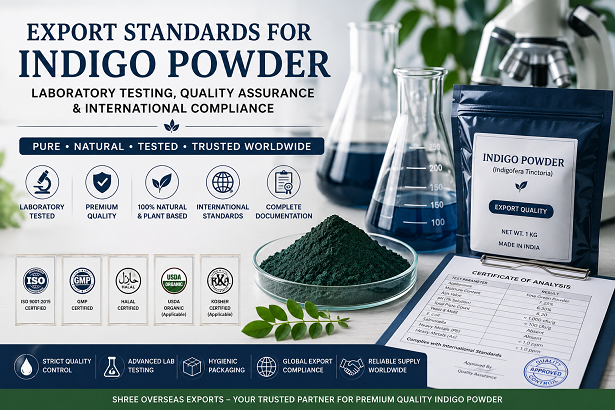
Professional exporters maintain documented quality control procedures to ensure every shipment remains consistent, safe, and fully traceable throughout the supply chain.
International Certifications and Documentation for Export
International buyers expect indigo powder manufacturers to operate under documented quality management systems and provide complete technical documentation with every shipment. These documents help buyers verify product authenticity, ensure regulatory compliance, and simplify customs clearance procedures.
Although documentation requirements differ depending on the destination country and intended product application, professional exporters generally maintain internationally recognized manufacturing practices and quality assurance systems.
Common certifications and documents requested by global buyers include:
- ISO 9001 Quality Management System
- Good Manufacturing Practices (GMP)
- Certificate of Analysis (COA)
- Safety Data Sheet (SDS/MSDS)
- Technical Data Sheet (TDS)
- Certificate of Origin
- Commercial Invoice
- Packing List
- Batch Traceability Records
- Export Inspection Documentation (where applicable)
Providing complete documentation improves buyer confidence while reducing customs delays. Manufacturers capable of maintaining proper production records and traceability systems are generally preferred by international cosmetic brands and herbal product companies.
Businesses planning to launch their own herbal hair color products can also benefit from our OEM & Private Label Manufacturing Services, which support customized formulations, branding, and export packaging.
Packaging Standards for Export Quality Indigo Powder
Proper packaging plays a critical role in preserving the quality of indigo powder during international transportation. Because herbal powders can absorb moisture and become contaminated if stored improperly, export packaging must provide excellent protection against humidity, light, dust, and physical damage.
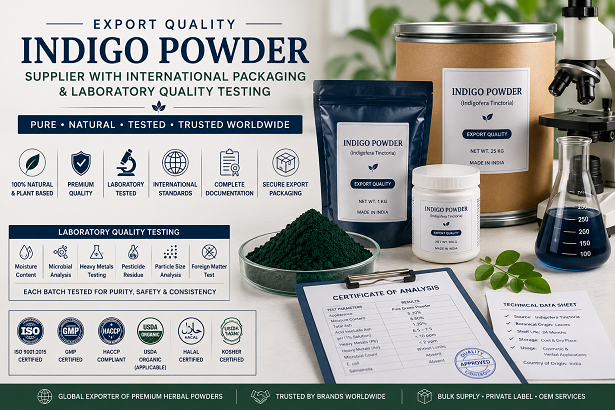
Professional manufacturers generally use food-grade or pharmaceutical-grade packaging materials depending on customer requirements. Packaging is selected according to shipment size, transportation method, and destination country.
Common export packaging options include:
- Food-grade laminated pouches
- HDPE containers
- Multi-layer kraft paper bags with inner liner
- Fiber drums
- Corrugated export cartons
- Customized private-label retail packaging
Export packaging typically contains important information such as:
- Product Name
- Botanical Name
- Batch Number
- Manufacturing Date
- Expiry Date
- Net Weight
- Country of Origin
- Storage Instructions
- Manufacturer Details
High-quality packaging minimizes contamination risks while helping maintain product freshness throughout shipping and warehouse storage.
How International Buyers Select a Reliable Indigo Powder Supplier
Selecting the right manufacturing partner involves much more than comparing quotations. Experienced buyers evaluate production capability, quality systems, export experience, customer support, documentation, and long-term supply reliability before approving suppliers.
The following factors are commonly evaluated during supplier qualification:
| Evaluation Factor | Importance |
|---|---|
| Manufacturing Experience | Ensures consistent product quality. |
| Quality Control Laboratory | Supports regular testing and batch consistency. |
| Raw Material Traceability | Improves supply chain transparency. |
| Documentation | Simplifies regulatory compliance. |
| Packaging Capability | Protects products during export. |
| OEM Services | Supports private-label businesses. |
| Export Experience | Reduces shipping and customs risks. |
| Production Capacity | Supports long-term contracts. |
Reliable manufacturers also maintain responsive communication, transparent business practices, and the ability to customize packaging according to customer requirements. These capabilities make long-term business partnerships more efficient and dependable.
Global Applications Driving Export Demand for Indigo Powder
Growing consumer interest in natural personal care products has significantly increased worldwide demand for indigo powder. Manufacturers increasingly use botanical ingredients instead of synthetic alternatives to meet consumer expectations for cleaner formulations and naturally derived products.
Today, export-quality indigo powder is widely used in:
- Herbal hair dyes
- Natural hair coloring products
- Ayurvedic hair care
- Private-label cosmetic manufacturing
- Professional salon products
- Organic beauty brands
- Botanical cosmetic formulations
- Natural personal care products
The increasing popularity of herbal hair colors has further strengthened demand for premium-quality indigo powder. Businesses serving international markets require consistent botanical ingredients that perform reliably across different formulations and production batches.
For readers interested in learning how export-quality herbal hair colors are produced, we also recommend our related article: How Herbal Hair Dyes Are Manufactured for International Export .
Companies manufacturing indigo powder alongside premium herbal ingredients, essential oils, and carrier oils are well positioned to serve the growing global market for natural cosmetic products.
Buyer Checklist Before Importing Export-Quality Indigo Powder
Selecting the right supplier is one of the most important decisions for cosmetic manufacturers, herbal hair care brands, distributors, and importers. A reliable exporter provides not only high-quality products but also consistent documentation, technical support, and dependable long-term supply.
Before placing your first international order, buyers should evaluate the following points:
- ✔ Confirm the botanical source as Indigofera tinctoria.
- ✔ Request the latest Certificate of Analysis (COA).
- ✔ Review microbiological and heavy metal test reports.
- ✔ Ask for Technical Data Sheet (TDS) and Safety Data Sheet (SDS/MSDS).
- ✔ Verify GMP and ISO quality management practices.
- ✔ Check the manufacturer's export experience and production capacity.
- ✔ Ensure packaging complies with international shipping standards.
- ✔ Confirm batch traceability and quality assurance procedures.
- ✔ Evaluate OEM and private-label manufacturing capabilities.
- ✔ Review customer support and communication responsiveness.
Importers who carefully evaluate these factors are more likely to establish long-term business partnerships while minimizing supply-chain risks and maintaining consistent product quality.
Future Market Outlook for Indigo Powder
The international market for indigo powder continues to expand as consumers increasingly seek naturally derived ingredients for personal care products. Growing awareness of herbal hair care, clean beauty, plant-based cosmetics, and sustainable manufacturing practices has strengthened global demand for export-quality indigo powder.
Manufacturers are increasingly developing innovative herbal formulations that combine indigo powder with henna, amla, bhringraj, aloe vera, and other botanical ingredients to produce premium hair coloring solutions. This trend has created new opportunities for suppliers capable of delivering standardized export-quality herbal powders.
Private-label manufacturing is also driving market growth. Beauty brands around the world increasingly partner with experienced manufacturers that can provide formulation assistance, customized packaging, regulatory documentation, and scalable production for international distribution.
As regulatory expectations continue to evolve, companies investing in quality assurance systems, laboratory testing, traceability, and sustainable manufacturing practices will remain well positioned for future export growth.
For internationally recognized guidance on quality management systems and standards, buyers can also refer to the International Organization for Standardization (ISO), which develops globally accepted standards for manufacturing and quality management.
Conclusion
Export-quality indigo powder represents far more than a traditional herbal ingredient. It is a carefully processed botanical product whose quality depends on responsible sourcing, hygienic manufacturing, laboratory testing, documentation, and professional packaging. Meeting international export standards enables manufacturers to supply reliable products for cosmetic companies, herbal hair care brands, wholesalers, and distributors worldwide.
Businesses looking to source premium indigo powder should prioritize suppliers with established quality management systems, transparent documentation, modern production facilities, and strong export experience. Choosing the right manufacturing partner improves product consistency, simplifies regulatory compliance, and supports long-term business growth.
At Shree Overseas Exports, we manufacture and export premium-quality herbal powders, herbal hair colors, essential oils, carrier oils, and natural cosmetic ingredients for customers across global markets. Our commitment to quality assurance, export compliance, and customer satisfaction enables us to support businesses ranging from startups to established international brands.
Frequently Asked Questions (FAQs)
1. What documents are required for exporting indigo powder?
Export shipments commonly include a Certificate of Analysis (COA), Technical Data Sheet (TDS), Safety Data Sheet (SDS/MSDS), Certificate of Origin, commercial invoice, packing list, and other documents required by the destination country.
2. Why is laboratory testing important for indigo powder?
Laboratory testing confirms botanical identity, microbial safety, moisture content, heavy metals, pesticide residues, and overall product quality before export.
3. Which industries use export-quality indigo powder?
Indigo powder is widely used in herbal hair dyes, natural hair color formulations, Ayurvedic products, cosmetic manufacturing, organic beauty products, and private-label hair care brands.
4. How should indigo powder be packaged for international export?
Professional exporters generally use food-grade laminated bags, HDPE containers, fiber drums, or customized private-label packaging designed to protect the powder from moisture and contamination during transportation.
5. What should buyers consider before selecting an indigo powder supplier?
Buyers should evaluate manufacturing capability, quality assurance systems, laboratory testing, export documentation, certifications, production capacity, packaging quality, and customer support before making purchasing decisions.
6. Does Shree Overseas Exports supply indigo powder in bulk?
Yes. Shree Overseas Exports manufactures and exports premium-quality indigo powder along with herbal hair colors, henna products, herbal powders, essential oils, and private-label manufacturing solutions for international customers.
If you want expert help, contact us and we will guide you accordingly.