Indigo Powder Uses in Cosmetics: Benefits, Applications and Formulation Insights
Indigo powder uses in cosmetics have expanded as cosmetic manufacturers and natural personal care brands increasingly explore plant-based ingredients for hair and beauty formulations. Traditionally associated with natural hair colouring, indigo powder is now attracting attention from manufacturers looking for botanical ingredients that can be incorporated into herbal hair care and selected cosmetic products.
Indigo powder is generally obtained from the leaves of Indigofera tinctoria. After harvesting and controlled processing, the leaves are converted into a finely milled botanical powder. Its natural colouring properties make it particularly relevant to herbal hair colour formulations, especially when it is used as part of carefully developed blends with other botanical ingredients.
For cosmetic businesses, however, choosing an indigo powder is not simply about colour. Factors such as botanical identity, raw material quality, processing hygiene, particle size, moisture control, microbiological quality, documentation, packaging and consistency can influence whether the ingredient is appropriate for a commercial formulation.
If you are researching the ingredient from a manufacturing or sourcing perspective, you may also find our guides on What is Indigo Powder? Benefits and Market Demand, Key Factors in Indigo Powder Manufacturing, Export Standards for Indigo Powder, and Natural Henna-Based Hair Dye vs Chemical Hair Color helpful.
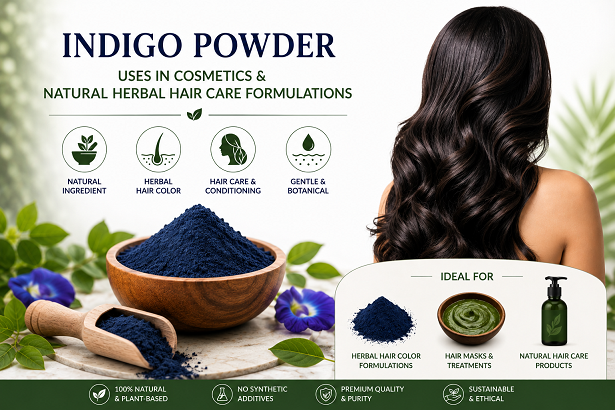
What Is Indigo Powder and Why Is It Used in Cosmetics?
Indigo powder is a botanical powder traditionally produced from the leaves of Indigofera tinctoria. The ingredient has a long history of use as a natural colouring material, particularly in traditional textile applications and herbal hair care practices.
In modern cosmetic manufacturing, its most established relevance is in natural and herbal hair colour formulations. Cosmetic brands may use indigo powder as part of botanical hair colouring systems, often alongside henna and other plant-derived ingredients.
The growing interest in botanical cosmetics has also encouraged manufacturers to examine plant-based ingredients according to more structured quality and formulation requirements. A natural origin alone does not automatically make an ingredient suitable for every cosmetic application. The intended use, formulation design, processing quality and applicable regulatory requirements should always be considered.
For businesses developing commercial cosmetic products, indigo powder can therefore be viewed primarily as a specialized botanical colour ingredient rather than a universal cosmetic additive.
What Are the Main Uses of Indigo Powder in Cosmetics?
The most important applications of indigo powder are concentrated around herbal hair care and natural hair colouring. Its natural pigment characteristics make it particularly relevant to brands developing alternatives to conventional hair colouring systems.
| Cosmetic Application | How Indigo Powder Is Used | Typical Product Category |
|---|---|---|
| Herbal Hair Colour | Used as a botanical colouring ingredient in carefully formulated hair colour systems. | Natural and herbal hair colour |
| Henna-Based Hair Colour | Combined with or used alongside henna to develop darker hair colour shades. | Henna and indigo hair colour |
| Powder Hair Treatments | Included in dry botanical hair care blends designed for consumer mixing before application. | Herbal hair treatment powders |
| Private Label Hair Products | Supplied as a botanical ingredient for customized branded formulations. | Private label hair care |
| Botanical Hair Care Blends | Combined with selected herbal powders according to the intended formulation. | Natural hair care products |
The actual suitability of indigo powder depends on the formulation, intended cosmetic claim, target market and applicable regulations. Cosmetic manufacturers should therefore evaluate the ingredient according to their specific product development requirements.
How Is Indigo Powder Used in Herbal Hair Colour Products?
One of the best-known indigo powder uses in cosmetics is natural hair colouring. Indigo powder is commonly associated with botanical hair colour systems because its natural colour characteristics can contribute to darker shades when appropriately formulated.
A particularly common approach is to use indigo powder with henna. Depending on the formulation method, proportions and application process, botanical hair colour systems may be designed to produce shades ranging from brown to deeper brown and black.
However, cosmetic manufacturers should avoid treating colour outcomes as guaranteed. Results can vary according to:
- Natural hair colour
- Hair condition and porosity
- Quality and origin of botanical ingredients
- Particle size of the powders
- Formulation ratios
- Preparation method
- Application time
- Previous chemical treatment of the hair
This is why commercial cosmetic manufacturers generally conduct formulation trials and batch testing before launching a finished product.
Businesses interested in this application can also read our detailed guide on how herbal hair dyes are manufactured for international export.
Can Indigo Powder Be Used in Natural Hair Care Formulations?
Yes, indigo powder can be incorporated into certain natural and herbal hair care formulations, particularly those designed around botanical hair colouring. Its strongest commercial relevance is in dry powder-based systems and herbal hair colour products.
Depending on the product concept, manufacturers may formulate indigo powder alongside ingredients such as henna and other botanical powders. The exact combination should be determined through product development and compatibility testing rather than simply mixing ingredients based on their individual popularity.
For a commercial formulation, manufacturers should consider:
- Botanical identity and authenticity
- Ingredient purity
- Particle size and texture
- Moisture content
- Microbiological quality
- Compatibility with other ingredients
- Packaging requirements
- Product stability
- Consumer instructions
- Applicable cosmetic regulations in the target market
This quality-focused approach is especially important for private label brands because the finished product represents the brand's reputation, not just the raw material supplier.
Why Is Indigo Powder Quality Important for Cosmetic Manufacturers?
Natural botanical ingredients can show greater variability than standardized synthetic raw materials because agricultural conditions, harvesting, processing and storage can influence their characteristics.
For indigo powder, raw material selection and processing controls are therefore important considerations for commercial buyers. A supplier should be able to explain the botanical source, manufacturing process, quality controls and documentation available for the product.
| Quality Parameter | Why It Matters |
|---|---|
| Botanical Identity | Helps confirm that the material corresponds to the specified botanical source. |
| Purity | Helps reduce concerns about unnecessary fillers or foreign materials. |
| Moisture Content | Supports product stability and appropriate storage. |
| Particle Size | Influences texture, dispersion and ease of formulation. |
| Microbiological Quality | Important for maintaining the safety and quality of botanical raw materials. |
| Heavy Metal Testing | Helps buyers evaluate compliance with applicable requirements. |
| Batch Consistency | Supports predictable manufacturing and finished-product performance. |
| Documentation | Provides technical information needed for procurement and quality evaluation. |
A professional quality assurance system can include identity verification, moisture analysis, microbiological testing, foreign matter inspection, particle size assessment and other tests appropriate to the product specification.
For a broader understanding of manufacturing controls, see our article on key factors to keep in mind in indigo powder manufacturing.
What Cosmetic Products Can Be Developed Using Indigo Powder?
Indigo powder is most relevant to cosmetic products where its natural colouring characteristics are part of the product concept. It should not be assumed that the ingredient is appropriate for every category of skincare or personal care product.
Potential product categories may include:
- Herbal hair colour powders
- Henna and indigo hair colour systems
- Botanical hair colouring blends
- Private label herbal hair colour products
- Natural hair care powder blends
- Selected botanical hair treatment products
The finished formulation should be developed according to the intended use and the regulatory requirements of the market where the product will be sold.
For example, a manufacturer developing a private label herbal hair colour should consider not only the raw ingredient but also the finished product's instructions, packaging, safety information, stability, claims and required documentation.
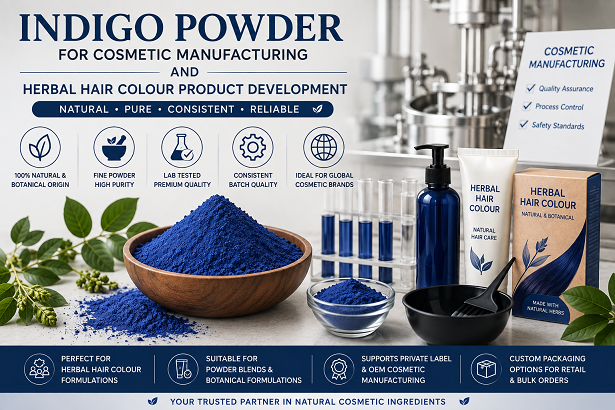
How Should Cosmetic Brands Evaluate an Indigo Powder Supplier?
Choosing an appropriate supplier is one of the most important steps when developing an indigo-based cosmetic product. The lowest price does not necessarily represent the best commercial value. Consistency, documentation, communication and quality assurance can have a much greater impact on long-term product performance.
Before placing a commercial order, cosmetic companies should evaluate:
- Botanical raw material sourcing
- Manufacturing and processing facilities
- Quality assurance procedures
- Laboratory testing capabilities
- Available product specifications
- Certificate of Analysis (COA)
- Safety Data Sheet or relevant technical documentation
- Batch traceability
- Packaging options
- OEM and private label capabilities
- Minimum order quantities
- Export experience
A supplier capable of supporting both technical and commercial requirements can make the product development process more efficient, particularly for brands entering international markets.
If you are comparing suppliers for international procurement, our article on how to choose the best indigo powder wholesale supplier in India provides additional considerations.
What Role Does Packaging Play in Indigo Powder Cosmetic Applications?
Packaging is an important part of maintaining the quality of powdered botanical ingredients. Indigo powder should be protected from excessive moisture, contamination and unsuitable storage conditions throughout its supply chain.
For commercial cosmetic applications, packaging may be selected according to the buyer's quantity, distribution model and private label requirements.
| Packaging Type | Potential Use |
|---|---|
| Small Retail Pouches | Consumer-facing herbal hair colour products. |
| 500 g – 1 kg Packs | Small-scale manufacturing and private label production. |
| 5 kg – 10 kg Packs | Commercial cosmetic manufacturing. |
| 20 kg – 25 kg Export Packs | Bulk ingredient supply and international procurement. |
| Customized OEM Packaging | Private label and branded cosmetic products. |
The packaging format should be selected according to the product specification and the conditions expected during storage and transportation. Appropriate batch identification and labeling also support traceability.
Is Indigo Powder Suitable for Private Label Cosmetic Brands?
Indigo powder can be a useful ingredient for private label brands developing herbal and botanical hair colour products. Private label manufacturing allows a business to develop a product under its own brand while working with an experienced manufacturer for sourcing, processing, packaging and production support.
For a successful private label product, brands should define their requirements before manufacturing begins. These may include:
- Desired product format
- Ingredient specification
- Target customer
- Packaging size
- Branding requirements
- Target export market
- Product documentation
- Testing requirements
- Minimum order quantity
- Shipping and packaging specifications
A clear product brief helps the manufacturer understand the commercial objective and reduces unnecessary formulation or packaging changes later in the development process.
Businesses interested in customized cosmetic manufacturing can also explore our skin and cosmetics product manufacturing services and hair care product manufacturing solutions.
What Should Buyers Check Before Using Indigo Powder in a Cosmetic Formula?
Before incorporating indigo powder into a commercial cosmetic formulation, buyers should evaluate the ingredient against their own technical specifications and applicable regulations. Natural ingredients still require responsible quality assessment.
A practical procurement checklist includes:
- Confirm the botanical name and product identity.
- Request a current product specification.
- Review the available Certificate of Analysis.
- Check microbiological quality requirements.
- Evaluate moisture specifications.
- Discuss particle size requirements.
- Confirm packaging and storage conditions.
- Conduct formulation compatibility trials.
- Evaluate finished-product stability.
- Check cosmetic regulations applicable to the destination market.
Brands should also ensure that marketing claims are appropriate and supported by the finished product's formulation and available evidence. Being a natural ingredient does not by itself justify unlimited cosmetic or performance claims.
Indigo Powder vs Other Botanical Hair Colour Ingredients
Indigo powder is one of several botanical ingredients used in natural hair care. Its role differs from ingredients that are primarily used for conditioning, texture, fragrance or other formulation purposes.
| Ingredient Type | Primary Cosmetic Role | Common Hair Care Application |
|---|---|---|
| Indigo Powder | Botanical colouring ingredient | Herbal hair colour formulations |
| Henna Powder | Botanical colouring and conditioning role | Natural hair colour products |
| Amla Powder | Botanical hair care ingredient | Herbal hair care blends |
| Shikakai Powder | Traditional botanical cleansing ingredient | Herbal hair cleansing products |
| Other Herbal Powders | Varies according to botanical source | Customized natural hair care formulations |
The choice of botanical ingredients should always be based on the desired product function rather than simply combining as many popular ingredients as possible. Proper formulation development is essential for achieving a consistent finished product.
Frequently Asked Questions (FAQs)
1. What are the main uses of indigo powder in cosmetics?
The main cosmetic use of indigo powder is in herbal and botanical hair colour products. It can be incorporated into hair colour systems, including formulations that use indigo alongside henna, depending on the desired product and formulation method.
2. Is indigo powder commonly used in natural hair colour products?
Yes. Indigo powder is particularly well known in botanical hair colour formulations. Its natural colouring characteristics make it relevant to herbal hair colour products and selected private label hair care formulations.
3. Can indigo powder be mixed with henna?
Indigo powder and henna are commonly used together in botanical hair colour systems. The resulting colour can vary according to the formulation, application method, natural hair characteristics and other factors, so manufacturers should conduct appropriate product testing.
4. Is indigo powder suitable for private label cosmetic products?
Yes, indigo powder can be used as an ingredient for private label herbal hair colour and selected botanical hair care products. Brands should work with a manufacturer that can provide suitable specifications, quality documentation, packaging and production support.
5. What quality tests should buyers consider for indigo powder?
Depending on the product specification and intended market, buyers may consider botanical identity, moisture content, particle size, microbiological quality, foreign matter and heavy metal testing, along with other relevant quality parameters.
6. Why is particle size important for cosmetic-grade indigo powder?
Particle size can influence the texture, dispersion, mixing behaviour and application characteristics of powdered cosmetic formulations. Consistent milling can therefore help manufacturers achieve more predictable processing and finished-product quality.
7. How should indigo powder be stored?
Indigo powder should generally be stored in suitable moisture-protective packaging in a cool, dry environment away from excessive humidity and direct sunlight. Buyers should follow the storage conditions specified by their supplier and product documentation.
8. How can I choose a reliable indigo powder manufacturer?
Evaluate the manufacturer's raw material sourcing, processing facilities, quality assurance system, laboratory testing, documentation, batch traceability, packaging options, production capacity and experience in serving cosmetic and international buyers.
9. Can indigo powder be used in every cosmetic product?
No. Indigo powder is primarily relevant to specific botanical hair colour and hair care applications. Its suitability for a particular cosmetic product should be determined through formulation development, safety assessment and compliance with applicable regulations.
10. Where can businesses source bulk indigo powder for cosmetic manufacturing?
Businesses should select suppliers based on product specifications, quality assurance, documentation, manufacturing capabilities, packaging requirements and export experience rather than price alone. A qualified supplier should be able to discuss the buyer's technical and commercial requirements.
If you want expert help, contact us and we will guide you accordingly.
Author
References
-
International Organization for Standardization (ISO)
https://www.iso.org -
World Health Organization (WHO) – Quality Control Methods for Herbal Materials
https://www.who.int - Relevant cosmetic regulations and technical requirements should be checked according to the destination market before commercial product launch.
Conclusion
The uses of indigo powder in cosmetics are most strongly associated with herbal hair colour and botanical hair care products. Its natural colouring characteristics make it an important ingredient for brands developing plant-based hair colour systems, particularly formulations involving henna and other botanical ingredients.
For cosmetic manufacturers, however, successful use of indigo powder involves more than selecting a natural ingredient. Raw material identity, purity, processing conditions, particle size, moisture control, microbiological quality, packaging and batch consistency all contribute to the quality of the final ingredient.
For private label and international cosmetic brands, supplier selection is equally important. A capable manufacturing partner can support businesses with bulk ingredient supply, quality documentation, packaging, OEM manufacturing and export requirements.
As consumer interest in botanical personal care continues to develop, cosmetic companies that combine responsible formulation practices with reliable sourcing and transparent quality systems can build stronger and more consistent natural hair care products.
Looking for Bulk Indigo Powder for Cosmetic Manufacturing?
Shree Overseas Exports supplies indigo powder for herbal hair colour, botanical hair care, cosmetic manufacturing and private label applications. We support businesses looking for bulk quantities, customized packaging and export-oriented supply solutions.
If you are developing a new herbal hair colour product or looking for a reliable botanical ingredient supplier, our team can discuss your required specifications, packaging, quantity and target market.